loader image

Serrated Safety Washers

Reliable Locking Under Dynamic Loads

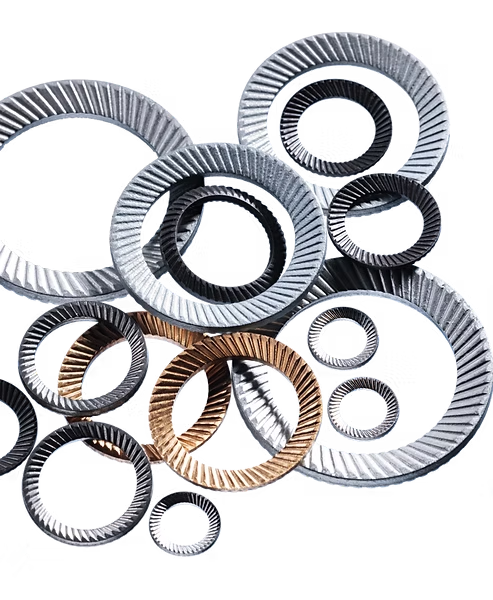
SCHNORR® Serrated Safety Washers are designed to maintain secure bolted connections in applications exposed to vibration, movement, and fluctuating loads. Featuring a conical shape with precision serrations, they provide effective locking performance while helping maintain consistent preload.

Trusted across a wide range of industrial sectors, SCHNORR® Serrated Safety Washers deliver dependable fastening security, durability, and long-term reliability in demanding operating environments.

Quick Facts

The original SCHNORR® safety washers were
developed as a reliable and economic bolt
locking device with the basic
principle of a disc spring. This ingenious form
combines the advantage of security through
friction and mechanical locking

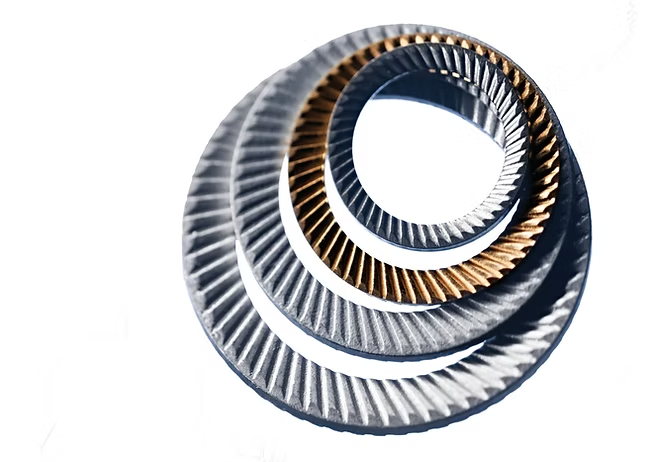
VS ONLY

  • Has a greater thickness for higher pre-tensioning loads

  • Used with high-strength bolts of the grade 10.9 without any restrictions.

  • Fits screws M 5 to M 30.

  • Applicable for elongated holes.

Features

Why engineers specify it

  • Equivalent locking effect to wedge-locking washers.

  • Wide variety for materials and different finishes.

  • High resistance to vibration

  • Uniform axial loading eliminates bending torques and deformation of the bolt stem.

  • Maintains initial bolt tension.

  • Applicable for clearance holes when there are safety washers on both sides

  • Designed for use in counterbores.

Common Usages

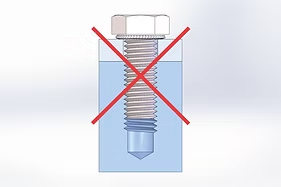
Correct
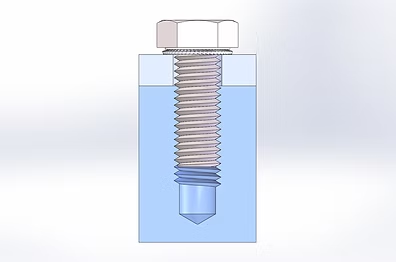
Incorrect

MATERIALS & SURFACES

Engineered material options

Carbon Steel

C60S (1.1211)
per DIN EN 10132-4
Used exclusively for Serrated Safety Washers & Load Washers.

Corrosion Resistant Stainless Steels

X5 CrNiMo 17-12-2 (1.4401)
per DIN EN 10151
Austenitic stainless steel with excellent corrosion resistance.

Bronze

CuSn8 (2.1030)
per DIN EN 1654
A copper alloy with tin. The strength values and spring forces resulting from it are considerably lower than with standard material.

Zinc Plated

Available Options:
Mechanical Zinc
Zinc Flake

Blackened

Nickel Plated
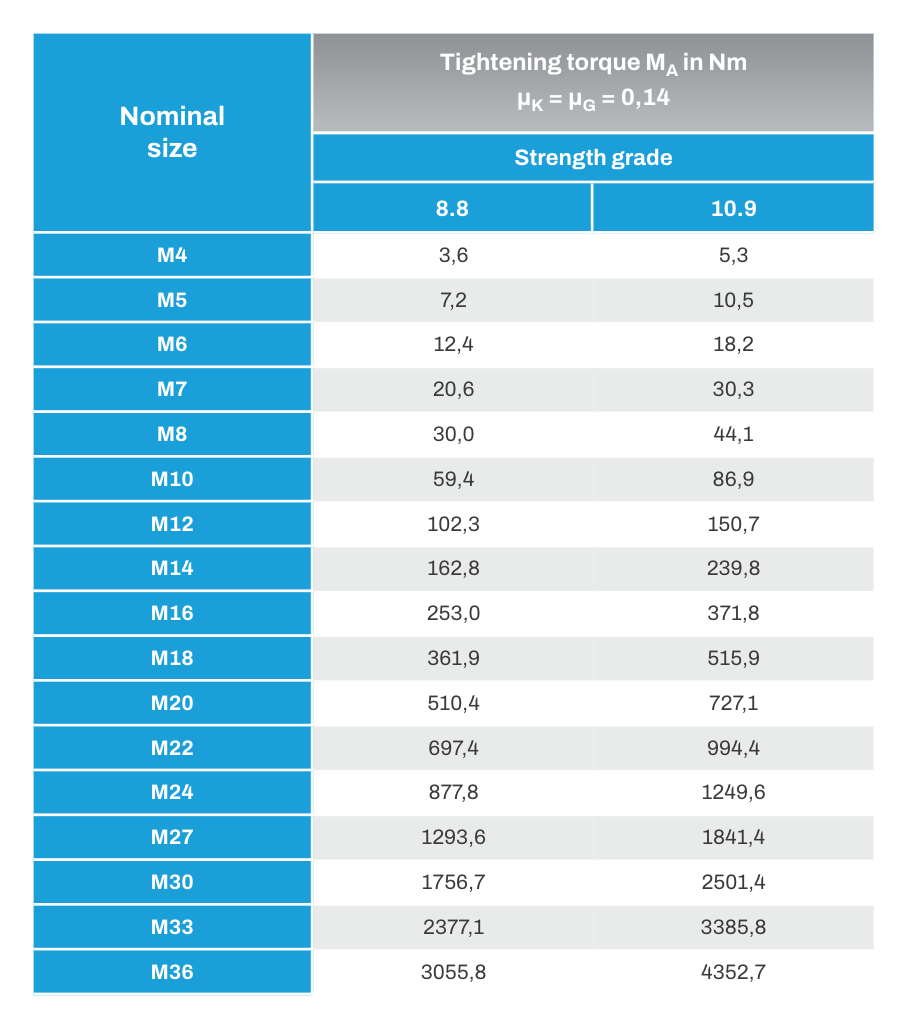
TIGHTENING TORQUES
Junker Tests
  • ​Connections secured using SCHNORR® Safety Washers maintain the pretension force after 2.000 cycles.

  • This test shows a superior locking performance compared to split lock washers, detent-edged washers, ribbed washers and spring washers.

  • Original SCHNORR® Safety Washer has an equivalent locking effect compared with a wedge-locking washer.

  • Download the full Junker Test presentation here.

Application Questions
What are the effects of different initial forces?
It is essential to tighten bolts to 100% of the initial force corresponding to the minimum required bolt tension. Tests show that when bolts are tightened to only 75% of the initial force they produced poor results where a certain percentage of the joints came loose. This effect was even more evident with only 50% initial force.
To reach the same initial force when using our type “S” washer, the initial torque has to be about 10% larger than for a bolt without securing device. The same applies to our type “VS” washer. Zinc-plated safety washers do not need the initial torque to be raised because the additional friction induced by the serrated surface is compensated by a lubrication effect of the zinc coating. The variation in initial torque is not greater with safety washers than in bolted connections without a securing device.
With increasing hardness of the base surface in the joint the “biting” effect of the serration decreases. The securing performance is directly correlated with this effect. The hardness of SCHNORR® Safety Washers is 39 –45 HRC (380–450 HV30), this applies only for higher hardness of the contact surface. We recommend to use the high duty type “VS” in combination with hardened surfaces. We also recommend tightening the bolt up to 100% of the force corresponding to the minimum required bolt tension.
The best securing effect is a black surface. However, zinc coated safety washers can secure a bolt joint perfectly as well, if the bolt is tightened with the appropriate initial force.
When tightened up to 100% of the minimum required bolt tension force, bolts without securing device do not loosen but the bolt head is being damaged considerably. Also, a relatively high initial torque is required. With type “VS” washers, the required initial torque is about 25% lower. The securing effect is good and the damages on the bolt head are only a little.
When a bolt joint secured with SCHNORR® Safety Washers is unscrewed and then tightened again, the securing effect does not diminish. The initial torque decreases only slightly, i.e. the originally applied momentum produces a slightly higher initial force. Our serrated safety washers can be used two or even more times without any restrictions! ​

SCHNORR® Serrated Safety Washers are designed to maintain secure bolted connections in applications exposed to vibration, movement, and fluctuating loads. Featuring a conical shape with precision serrations, they provide effective locking performance while helping maintain consistent preload.

Trusted across a wide range of industrial sectors, SCHNORR® Serrated Safety Washers deliver dependable fastening security, durability, and long-term reliability in demanding operating environments.

Quick Facts

The original SCHNORR® safety washers were developed as a reliable and economic bolt locking device with the basic principle of a disc spring. This ingenious form combines the advantage of security through friction and mechanical locking

Features

S & VS

  • Equivalent locking effect to wedge-locking washers.

  • Wide variety for materials and different finishes.

  • High resistance to vibration

  • Uniform axial loading eliminates bending torques and deformation of the bolt stem.

  • Maintains initial bolt tension.

  • Applicable for clearance holes when there are safety washers on both sides

  • Designed for use in counterbores.

VS ONLY

  • Has a greater thickness for higher pre-tensioning loads

  • Used with high-strength bolts of the grade 10.9 without any restrictions. 

  • Fits screws M 5 to M 30.

  • Applicable for elongated holes.

MATERIALS & SURFACES

Carbon Steel

C60S (1.1211)
per DIN EN 10132-4
Used exclusively for Serrated Safety Washers & Load Washers.

Corrosion Resistant Stainless Steels

X5 CrNiMo 17-12-2 (1.4401)
per DIN EN 10151
Austenitic stainless steel with excellent corrosion resistance.

Bronze

CuSn8 (2.1030)
per DIN EN 1654
A copper alloy with tin. The strength values and spring forces resulting from it are considerably lower than with standard material.

Blackened

Zinc Plated

Available Options:
Mechanical Zinc
Zinc Flake

Nickel Plated

Electroless

TIGHTENING TORQUES

JUNKER TEST
  • ​Connections secured using SCHNORR® Safety Washers maintain the pretension force after 2.000 cycles.

  • This test shows a superior locking performance compared to split lock washers, detent-edged washers, ribbed washers and spring washers.

  • Original SCHNORR® Safety Washer has an equivalent locking effect compared with a wedge-locking washer.

  • Download the full Junker Test presentation here.

APPLICATION QUESTIONS
What are the effects of different initial forces?
It is essential to tighten bolts to 100% of the initial force corresponding to the minimum required bolt tension. Tests show that when bolts are tightened to only 75% of the initial force they produced poor results where a certain percentage of the joints came loose. This effect was even more evident with only 50% initial force.
To reach the same initial force when using our type “S” washer, the initial torque has to be about 10% larger than for a bolt without securing device. The same applies to our type “VS” washer. Zinc-plated safety washers do not need the initial torque to be raised because the additional friction induced by the serrated surface is compensated by a lubrication effect of the zinc coating. The variation in initial torque is not greater with safety washers than in bolted connections without a securing device.
With increasing hardness of the base surface in the joint the “biting” effect of the serration decreases. The securing performance is directly correlated with this effect. The hardness of SCHNORR® Safety Washers is 39 –45 HRC (380–450 HV30), this applies only for higher hardness of the contact surface. We recommend to use the high duty type “VS” in combination with hardened surfaces. We also recommend tightening the bolt up to 100% of the force corresponding to the minimum required bolt tension.
The best securing effect is a black surface. However, zinc coated safety washers can secure a bolt joint perfectly as well, if the bolt is tightened with the appropriate initial force.
When tightened up to 100% of the minimum required bolt tension force, bolts without securing device do not loosen but the bolt head is being damaged considerably. Also, a relatively high initial torque is required. With type “VS” washers, the required initial torque is about 25% lower. The securing effect is good and the damages on the bolt head are only a little.
When a bolt joint secured with SCHNORR® Safety Washers is unscrewed and then tightened again, the securing effect does not diminish. The initial torque decreases only slightly, i.e. the originally applied momentum produces a slightly higher initial force. Our serrated safety washers can be used two or even more times without any restrictions! ​